
Kitchen Painting Service Long Eaton
Free Consultation
01332-529933
“Kitchen Painting Service Long Eaton - Professional Kitchen Services by Derby Kitchen Fitter” is really about one question: does your kitchen need pulling out, or does it just need a proper respray? If the carcasses are sound, the doors aren't swollen or hanging off their hinges, and the only thing wrong is a colour you've gone off or a decade of grease and cooking steam dulling the finish, painting the kitchen you've already got usually gets you further for less money and far less mess than tearing it out.We're the same team behind full kitchen installations across Derby, and the spray-finishing side of the business grew out of exactly this problem - customers who loved their layout and their worktop but couldn't stand the door colour any more. Painting a kitchen properly is a trade in itself: get the primer wrong on a laminate or foil-wrapped door and you'll be looking at peeling within a year, which is why we treat it as a proper spray job, not a weekend brush-and-roller exercise.
On-Site or Workshop: How a Long Eaton Respray Actually Gets Sprayed
- A decision, made at the free site visit, on whether your doors are sprayed on-site in your Long Eaton kitchen or taken back to the Derby workshop for a controlled-environment finish - which one suits depends on the doors and the household, not a fixed house rule
- Colour matching against a specific reference, including Farrow & Ball and Little Greene shades, checked against your actual doors in your own kitchen's light rather than under workshop lighting
- The right primer for the substrate you've actually got - a lot of the kitchens we see on Long Eaton's newer estates off Derby Road and Tamworth Road have laminate or foil-wrapped doors that need an adhesion primer, while the older terraces nearer the town centre are more likely to have solid wood or MDF doors that take a standard primer
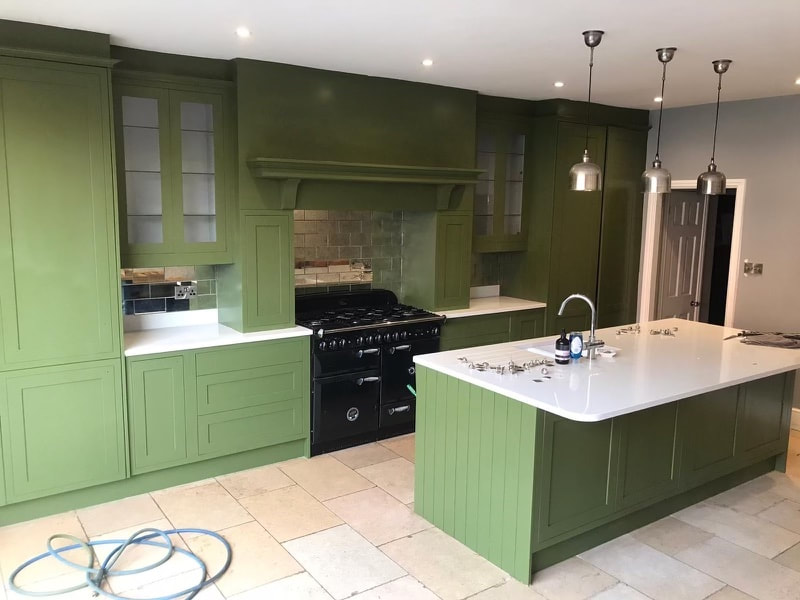
- Filling and sanding minor dents, chips and scratches before priming, so old damage doesn't show through the new finish
- Spraying of visible carcass ends, pelmets and cornices, not just the doors themselves, wherever they're seen from the room
- Removing and refitting existing handles, or fitting new hardware if you're changing the look at the same time
- Laminate worktop resurfacing alongside the cabinets where the worktop itself is structurally sound but tired-looking - a different job from stone or solid-surface worktop work, which is quoted separately
- Full protection of floors, appliances and the rest of the house for the work's duration, and legal removal of dust sheets, old hardware and offcuts as a registered waste carrier
Not Included / Costed Separately
- Doors that are swollen, delaminating at the edges or warped - no primer fixes a door that's already failing physically, and we'll say so at the site visit rather than spray over a problem that'll show through within months
- Structural changes to the kitchen layout - moving units or altering plumbing and electrics is a full fit, not a paint job
- Stone or solid-surface worktop replacement - granite, quartz and similar surfaces aren't sprayed; that's a separate job handled by the stone and solid-surface team
- Repairing water-damaged chipboard carcasses behind the doors - if damp has got into the carcass itself, that needs sorting before painting is worth doing
- Colour matching done from a photo sent in advance - because paint reads differently under different light, matching happens against your actual doors at the site visit, not by email beforehand
- New integrated appliances or appliance panel replacement, unless agreed as part of the same visit
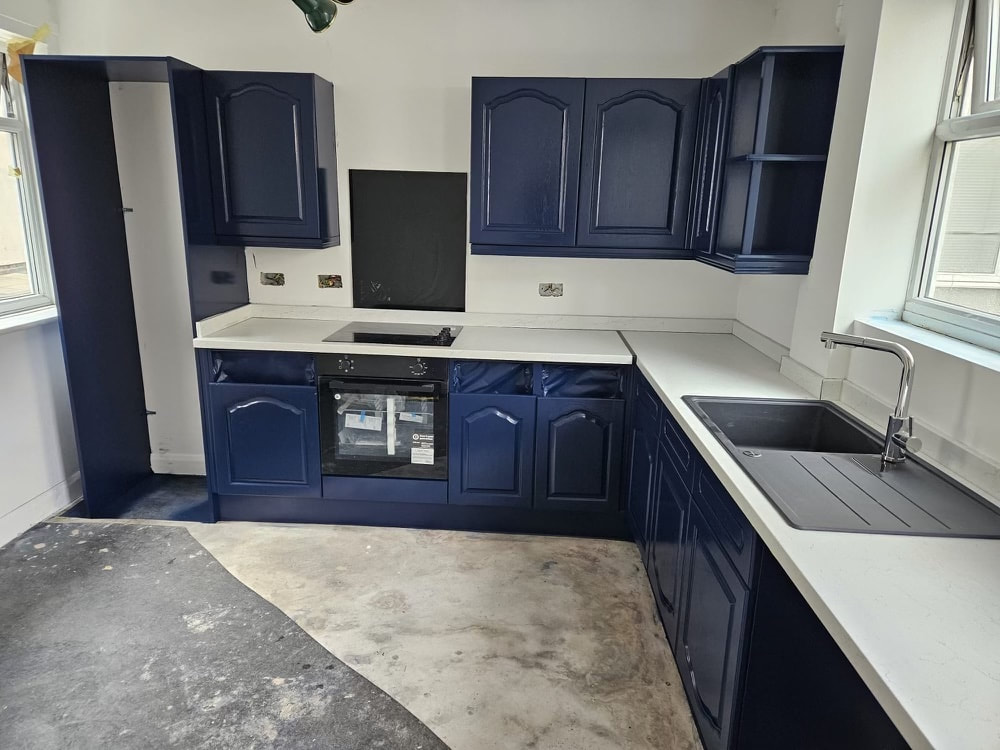
From First Call to a Finished Kitchen: How the Painting Work Runs
- Initial call: You tell us what you've got - door material if you know it, roughly how many doors and drawers, and the colour or finish you're after. This is also when we flag anything that might rule painting out, like doors you describe as swollen or falling apart.
- Free site visit: Someone comes out to Long Eaton to look at the actual doors, check the substrate (solid wood, MDF, laminate, foil or vinyl wrap), check for damp around the sink and hob, and count exactly what needs spraying. This is also when on-site versus workshop spraying gets decided for your kitchen. You get a written, itemised quote off the back of this visit, not a phone-based guess.
- Prep and protection: On the day, the kitchen gets masked and protected, doors are numbered and either removed to be sprayed in a controlled area or masked in place, then degreased and keyed back so the primer has something to bite into.
- Priming: The right primer goes on for the substrate you've got - this is the step that decides whether the finish lasts five years or starts lifting at the edges within one. Melamine and foil doors get an adhesion primer; anything near the sink gets a moisture-resistant coat first.
- Spray finishing: Doors are sprayed rather than brushed, in your matched colour, with the coats and drying time the finish needs between them. A sprayed finish reads as factory-smooth with no brush marks, which is the main reason people choose it over painting by hand.
- Refit and sign-off: Doors go back on, hardware is refitted or upgraded, and you get a walkthrough to check every door before the crew leaves, along with the written guarantee.