
Kitchen Cabinet Painting Techniques: Professional Methods for Derby Homes
Free Consultation
01332-529933
Cabinet painting is one of three specialist areas our workshop runs alongside bespoke joinery and stone worktop fitting, and it's treated as its own trade rather than a job squeezed in between installs. Doors come off their hinges, go through a set sequence of degreasing, filling, priming and multiple coats, and go back on - the same sequence whether the base is a solid oak door from the 1990s or a laminate carcass that has never held paint before.
For homeowners weighing up a full kitchen refit against simply repainting what's there, the short version is that painting saves the cost and disruption of ripping out sound carcasses, but it only holds up long-term if the surface prep and primer choice match the material underneath - which is where most DIY and cut-price jobs come unstuck.
Prep, Priming and Spraying: What's Actually Included
- Degreasing and full surface preparation of cabinet doors, drawer fronts and carcasses
- Repair of dents, chips and worn edges before priming
- Primer matched to the base material - bonding primer for melamine and laminate, stain-blocking primer for wood tannins
- Factory-grade, dust-free spray finishing, or brush and roller application where spraying isn't practical
- Colour matching to ranges such as Farrow & Ball or Little Greene
- Hinge, handle and hardware refitting once the finish has cured
- Removal and legal disposal of any doors or units that turn out to be beyond repair
Not Included / Costed Separately
- Replacement of cabinet carcasses that are structurally unsound - these need swapping out, not painting over
- Worktop, splashback or flooring work, which our stone and solid-surface team handles separately if it's part of the wider job
- Disconnecting or reconnecting sockets, hobs or plumbing around units, which needs a qualified electrician, Gas Safe engineer or plumber if appliances are in the way
- Foil-wrapped or laminate doors that have already delaminated - these typically need replacing rather than painting
How a Cabinet Painting Project Runs, Start to Finish
- Free consultation and assessment -- We look at your existing cabinets in person, identify the material - solid wood, MDF, melamine or previously painted - and talk through colour and finish options.
- Written, itemised quote -- You get a quote before any work starts, covering preparation, priming, coats and hardware refitting, so there are no surprises once the job is under way.
- Doors and drawers removed and labelled -- Cabinet doors, drawer fronts and any removable panels come off and are numbered so everything goes back exactly where it came from.
- Preparation and repair -- Degreasing, filling, sanding and repair work happens before any primer goes on - this stage takes the longest and is what separates a finish that lasts from one that chips within a year.
- Priming and spray or brush application -- Primer suited to the base material goes on first, followed by multiple coats applied by spray in a controlled, dust-free area, or by brush and roller where spraying isn't the right approach for that surface.
- Refit and sign-off -- Once cured, hardware is refitted, doors are rehung and aligned, and we walk through the finished units with you before confirming the guarantee in writing.
What Drives the Price of a Cabinet Respray
Cabinet painting costs depend on the number of doors and drawers, the material underneath, how much repair work the existing surface needs, and whether spraying or brush application is the right method for your kitchen - previously painted MDF doors in reasonable condition cost less to prepare than delaminating laminate or damaged solid wood. We give a written, itemised quote after seeing the cabinets in person rather than pricing over the phone, so the figure you're quoted is the figure you pay, with nothing added once the work starts.
Repainting, Respraying or Replacing - Which Suits Your Kitchen?
| Option | Typical finish | Disruption | Best suited to |
|---|---|---|---|
| Brush and roller repaint | Good, but more likely to show brush marks close up | Lower - can sometimes be done with cabinets left in place | Smaller jobs, tighter budgets, or touching up existing paintwork |
| Factory-grade spray finishing | Smooth, even coat close to a factory finish | Doors removed and sprayed in a dust-free area; carcasses stay in the kitchen | A whole-kitchen respray where appearance matters most |
| Full cabinet replacement | New material, wider choice of styles and colours | Highest - carcasses come out, kitchen unusable for longer | Units that are damaged, poor quality, or the wrong layout for the space |
Why We Say No to a Respray Sometimes - and What That Looks Like on Site
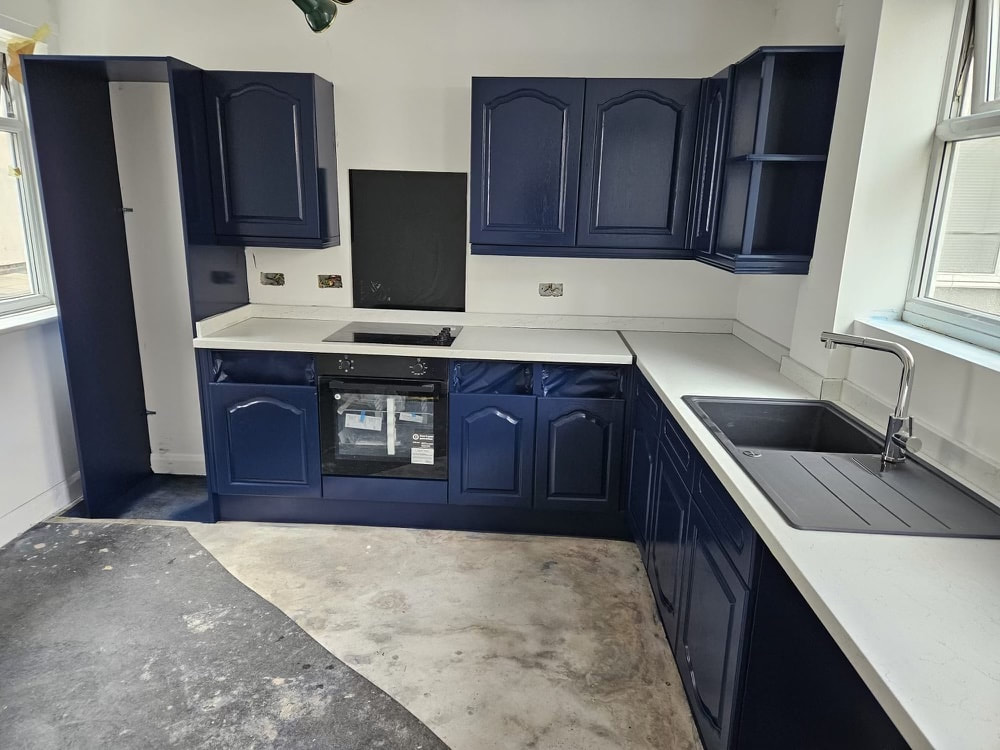
Most of the cabinet respray jobs that come through the workshop follow the same basic pattern: a kitchen that's structurally fine - carcasses square, doors hanging properly - but a finish that's dated or taken a beating from a decade or two of cooking and cleaning. A typical example is a 1990s solid oak kitchen with yellowed varnish and worn patches around the handles, where the right call is to strip it back to bare timber, fill and sand it, then spray it in a modern flat or satin colour rather than tearing out cabinets that still do their job structurally. We make that judgement on-site rather than defaulting to a sale - if a carcass is sound, we say so, and if it's beyond saving, we say that too rather than painting over a problem that will show through within a year. The spraying itself is carried out by our own trades rather than passed to a subcontractor, carries our 5-year guarantee on installation and workmanship plus 2 years on materials, and any doors or units that do get swapped out are removed by us as a registered waste carrier. We've been doing this kind of work across Derby and the surrounding towns for around 20 years, and we're members of CITB and FSB.
How Far We Travel for Cabinet Respray Work, and What Changes Along the Way
Cabinet respray jobs take us out from the workshop at Sunny Hill across the wider county on a regular basis, and it's the age and material of the kitchen as much as the postcode that shapes how a job is planned. Heading north east we cover Heanor, Ripley and Alfreton through to Chesterfield and Dronfield; south west takes in Swadlincote and Long Eaton; and toward the Dales we regularly respray kitchens in Belper, Duffield, Wirksworth, Matlock, Bakewell and Buxton, along with Ilkeston and homes across Nottingham and Nottinghamshire, including West Bridgford. Older properties in the Dales towns - Wirksworth and Bakewell especially - often still have their original solid wood units, which need a stain-blocking primer rather than the bonding primer we'd reach for on a newer laminate kitchen nearer Derby, and on damp days out towards Buxton we build in extra curing time between coats rather than rushing the finish. Wherever the job is, it's the material and condition of the cabinets, not the postcode, that decides how the work is done.
Cabinet Painting Questions We're Asked Most
Can you paint MDF, melamine or laminate cabinet doors, or only solid wood?
Yes - melamine and laminate need different preparation to solid wood because the surface is slick rather than porous, so we abrade it and use a bonding primer designed for those materials rather than the stain-blocking primer we'd use on wood tannins. As long as the laminate itself hasn't started peeling or delaminating, it can usually be painted rather than replaced.
Do you spray on site, or do the doors come off to a workshop?
Doors and drawer fronts are removed, numbered, and sprayed in a controlled, dust-free area, while carcasses that stay fixed in the kitchen are prepared and finished in place. This keeps overspray and dust out of the rest of the house.
How long does a full kitchen cabinet respray take?
It depends on the number of doors, how much repair and preparation the existing surface needs, and how many coats the finish requires to cure properly between applications. We give a realistic timescale as part of the written quote once we've seen the cabinets, rather than a generic figure that doesn't account for your kitchen.
Can you match a specific paint colour, like Farrow & Ball or Little Greene?
Yes - colour matching to ranges including Farrow & Ball and Little Greene is part of our resurfacing and spray finishing work, so you're not limited to a standard trade colour card.
Will painted cabinets hold up to daily kitchen use - cooking, cleaning, steam?
With the right primer and a paint system designed for kitchens, properly prepared and applied cabinet paint holds up to normal cooking, cleaning and steam. The preparation stage - degreasing, filling and priming - matters more to long-term durability than the paint itself, which is why we don't skip it to save time.
What happens if a cabinet door turns out to be too damaged to paint?
If a door or drawer front has damage that can't be filled and sanded back invisibly - split laminate, warped MDF, or structural damage to the carcass - we'll tell you honestly rather than paint over it, and can talk through replacing that individual piece as part of the same project.
Ready to See What Your Existing Cabinets Could Look Like?
The longer a worn or dated finish is left, the more preparation it usually needs before paint will hold properly, so it's worth getting cabinets assessed while chips and wear are still minor. Get in touch for a free consultation and a written, itemised quote with no obligation to go ahead.
Kitchen Fitters Derby, Fitted Kitchens, Derby
Call 01332-529933
Factory • 5-Year Guarantee • Licensed Waste Removal
Quick Free Estimate - No Obligation
Fully Insured • Response within 15 mins
🔒 Your details are safe with us. No spam, ever.